
The cybersecurity landscape of 2026 has shifted from a “wait and see” approach to an aggressive, offensive-defense posture, emphasizing a robust proactive security posture. As Advanced Persistent Threats (APTs) and AI-driven malware become more sophisticated, the traditional firewall is no longer enough. Today, organizations must actively search for hidden adversaries within their networks before a breach occurs.
This is where threat hunting comes into play. Unlike standard automated alerts, threat hunting is a human-led, tool-augmented process that enhances overall threat detection capabilities and leverages advanced security analytics to identify “silent” threats that have already bypassed existing security controls. In this comprehensive guide, we explore the top 10 persistent threat hunting tools for 2026 that every security operations center (SOC) needs to stay ahead of the curve.
Why Threat Hunting is the Backbone of 2026 Security
In 2026, the average dwell time—the time an attacker remains undetected—has plummeted for those using modern tools, but skyrocketed for those relying on legacy systems. Persistent threat hunting is no longer a luxury; it is a necessity for survival.
Proactive hunting allows your team to find anomalies in encrypted traffic, identify lateral movement, and spot credential theft in real-time, often by understanding common adversary tactics, techniques, and procedures (TTPs). By assuming that a breach has already happened, “hunters” use high-fidelity data to root out attackers.
Key Features of Modern Threat Hunting Platforms
Before we dive into the list, it is essential to understand what makes a tool “top-tier” in the current year. The best tools in 2026 share several common characteristics:
- AI-Driven Correlation: The ability to link disparate events across cloud, endpoint, and network layers using generative AI.
- MITRE ATT&CK Mapping: Native integration with the latest MITRE frameworks to categorize adversary behavior accurately.
- Scalability: The capacity to ingest petabytes of data without significant latency.
- Automation (SOAR): The ability to trigger automated playbooks once a threat is identified.
The Top 10 Persistent Threat Hunting Tools for 2026
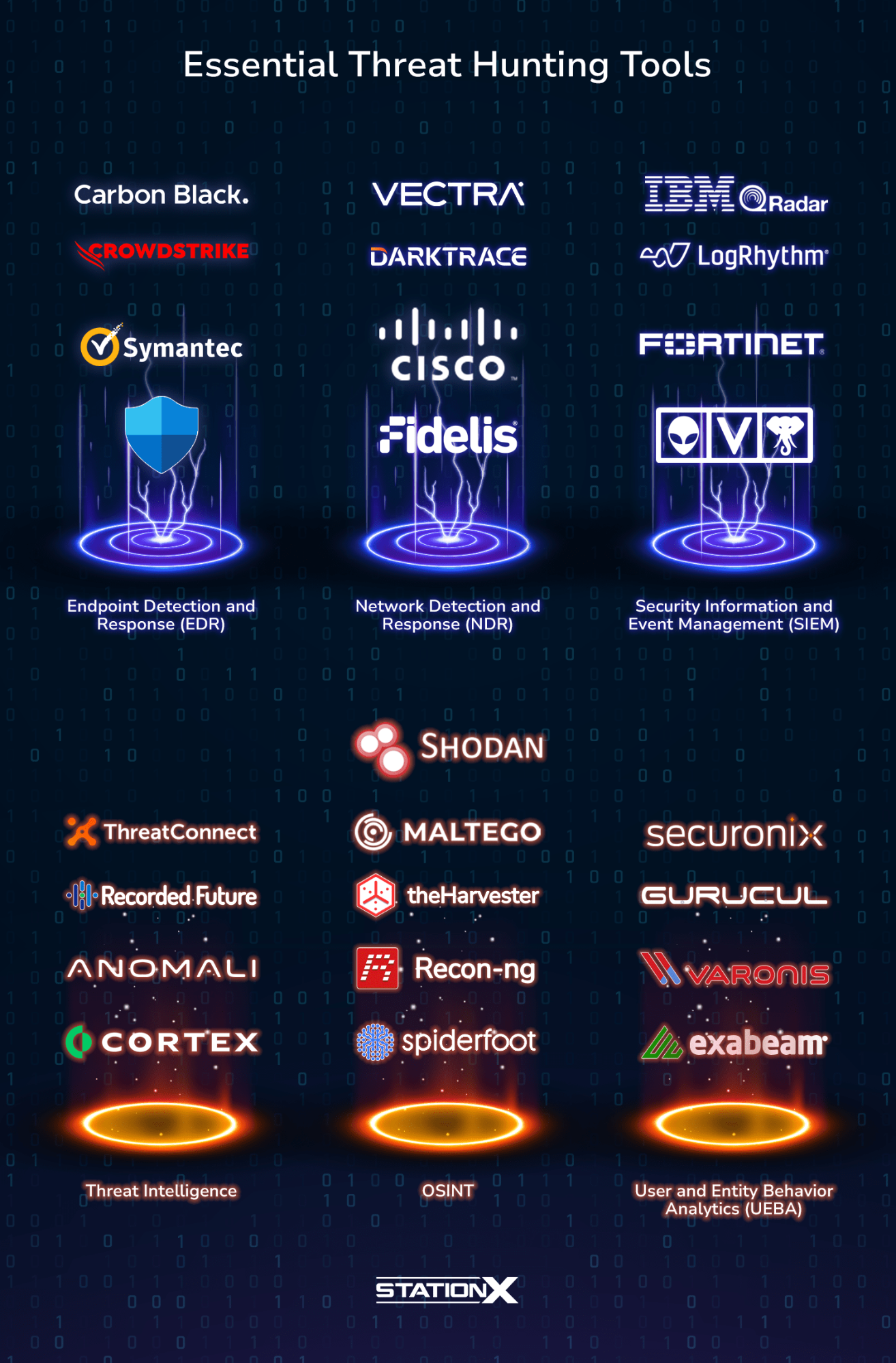
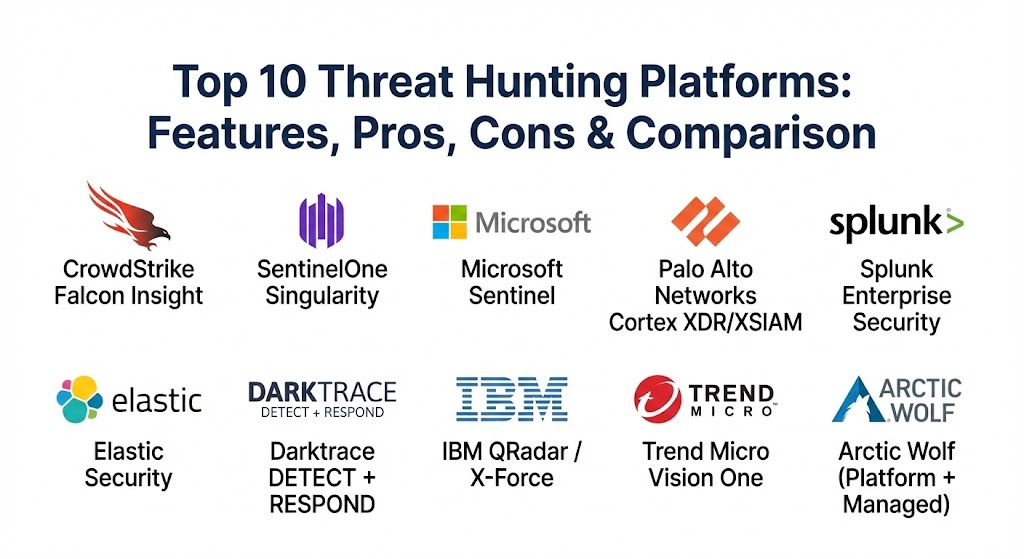
Here is our curated list of the most effective tools for identifying and neutralizing persistent cyber threats this year.
1. CrowdStrike Falcon (XDR & AI-Hunter)
CrowdStrike Falcon remains the gold standard for endpoint detection and response (EDR) and threat hunting. In 2026, its “Charlotte AI” assistant has evolved into a fully autonomous hunting partner. It allows analysts to ask complex natural language questions like, “Show me all lateral movement attempts using PowerShell in the last 48 hours.”
The platform’s Cloud-Native Architecture ensures that it can monitor remote workforces and multi-cloud environments seamlessly. Its ability to provide deep visibility into kernel-level activities makes it nearly impossible for rootkits to hide.
2. Microsoft Sentinel
As a cloud-native SIEM (Security Information and Event Management) and SOAR platform, enriched with robust cyber threat intelligence (CTI) feeds, Microsoft Sentinel has become a powerhouse. Its deep integration with the Microsoft 365 ecosystem and Azure makes it the go-to for enterprise-level hunting.
In 2026, Sentinel’s User and Entity Behavior Analytics (UEBA) is more refined than ever. It uses machine learning to establish a “normal” baseline for every user, making it incredibly easy to spot account takeovers or insider threats.
3. Splunk Enterprise Security
Splunk is often called the “Google for log data.” For threat hunters, its comprehensive log management capabilities and flexibility are its greatest power. You can ingest data from literally any source—firewalls, servers, IoT devices, and even physical security systems.
The Splunk Threat Hunter app provides pre-built dashboards and search queries specifically designed to find APTs. Its “Search Processing Language” (SPL) remains the most powerful tool for custom data manipulation in the industry.
4. Elastic Security (The ELK Stack)
Elastic Security has democratized threat hunting. Because it is built on the open-source ELK stack (Elasticsearch, Logstash, Kibana), it offers unparalleled speed. In 2026, its integrated EDR (Endpoint Detection and Response) capabilities are free for basic use, making it a favorite for mid-market companies.
Hunters love Elastic for its “frozen tier” storage, which allows them to keep years of historical data searchable at a low cost—crucial for identifying long-term persistent campaigns.
5. RITA (Real Intelligence Threat Analysis)
If you are looking for an open-source powerhouse, RITA is the answer. Developed by Active Countermeasures, RITA excels at Network Traffic Analysis (NTA) and broader network security monitoring (NSM). It specializes in finding “beacons”—heartbeat-like signals that malware sends back to a Command and Control (C2) server.
RITA analyzes Zeek (formerly Bro) logs to find long-duration connections and DNS tunneling, which are classic hallmarks of persistent threats. In 2026, its ability to detect “jitter” in beaconing patterns makes it one of the most effective tools against sophisticated C2 frameworks.
6. SentinelOne Singularity
SentinelOne has gained massive ground in 2026 due to its “Storyline” technology. This feature automatically groups related events into a single visual narrative. For a threat hunter, this means you don’t have to manually piece together 50 different alerts; the tool does it for you.
Its Singularity Skylight feature allows for effortless data lake searching, enabling hunters to pivot from an endpoint alert to a network-wide investigation in seconds.
7. Palo Alto Networks Cortex XDR
Cortex XDR, a leading extended detection and response (XDR) platform, is the first to truly integrate network, endpoint, and cloud data into a single repository. By breaking down these silos, Palo Alto Networks has made it much harder for attackers to hide in the “gaps” between security products.
In 2026, Cortex XDR’s Managed Threat Hunting service acts as an extension of your team, providing 24/7 expert analysis of your environment to find the threats your internal team might miss.
8. Maltego
Not all threat hunting happens inside your network. Maltego is a premier tool for Open Source Intelligence (OSINT) and link analysis. It allows hunters to map out the infrastructure of an attacker—finding their IP addresses, domains, and even social media profiles.
By visualizing the relationships between different pieces of data, Maltego helps hunters understand the “who” and “why” behind an attack, not just the “how.”
9. Wireshark
While it may be one of the oldest tools on this list, Wireshark remains indispensable in 2026. For deep-dive digital forensics investigations, nothing beats the ability to inspect individual packets.
When a hunter identifies a suspicious stream of traffic, Wireshark is the tool used to “dissect” that traffic and see exactly what data is being exfiltrated. It is the ultimate tool for ground-truth verification.
10. VMware Carbon Black
Now part of the Broadcom family, Carbon Black continues to lead in Predictive Security. Its focus on “Unfiltered Data” collection means it records everything happening on an endpoint, not just what it thinks is “bad.”
This “flight data recorder” approach is a goldmine for threat hunters. It allows them to “rewind the tape” and see exactly how an attacker gained entry, even if the event happened months ago.
How to Build a Successful Threat Hunting Strategy in 2026
Tools are only as good as the strategy behind them. To effectively hunt for persistent threats, your team should follow a structured loop:
Step 1: Formulate a Hypothesis
Don’t just look at data randomly. Start with a question: “If an attacker were to target our R&D database, how would they bypass our MFA?” This hypothesis guides your search.
Step 2: Investigation via Tools
Use the tools listed above to gather evidence. Check logs in Splunk, look for beacons in RITA, and examine endpoint processes in CrowdStrike.
Step 3: Reveal Patterns
Look for Indicators of Attack (IoAs) rather than just Indicators of Compromise (IoCs). While an IP address (IoC) can change, an attacker’s behavior (IoA)—such as dumping LSASS memory—is much harder to mask.
Step 4: Respond and Harden
Once a threat is found, don’t just kill the process. This is where robust incident response (IR) procedures come into play. Understand the root cause, update your firewall rules, address any identified weaknesses through effective vulnerability management, and automate a detection rule so the threat can’t return.
The Role of AI and Machine Learning in 2026 Hunting
In 2026, the “AI vs. AI” battle is in full swing. Attackers use AI to generate polymorphic code that changes its signature every few seconds. In response, threat hunting tools have integrated Generative Adversarial Networks (GANs) to predict how malware might evolve.
Behavioral Analytics has replaced signature-based detection. Instead of looking for a specific file hash, tools now look for “suspicious intent.” For example, a calculator app that suddenly tries to connect to an external IP address in Eastern Europe will be flagged immediately by any of the top 10 tools mentioned here.
Statistics: The Impact of Threat Hunting
According to recent 2026 industry reports:
Organizations with a dedicated threat hunting team reduce their data breach costs by an average of 45%.
72% of SOC managers state that proactive hunting is their most effective method for detecting “zero-day” exploits.
- The use of Cloud-Native XDR tools has increased by 300% since 2024, reflecting the shift toward decentralized work environments.
Conclusion: Staying Ahead of the Persistent Threat
The year 2026 demands a new level of vigilance. As cybercriminals become more persistent, our hunting must become more relentless. By leveraging a combination of AI-powered platforms like CrowdStrike, network-centric tools like RITA, and deep-dive forensic software like Wireshark, your organization can build a formidable defense.
Remember, the goal of threat hunting isn’t just to find a virus; it’s to find the human (or AI agent) behind the screen. With the right tools and a proactive mindset, you can turn your network from a target into a trap for any adversary brave enough to enter.